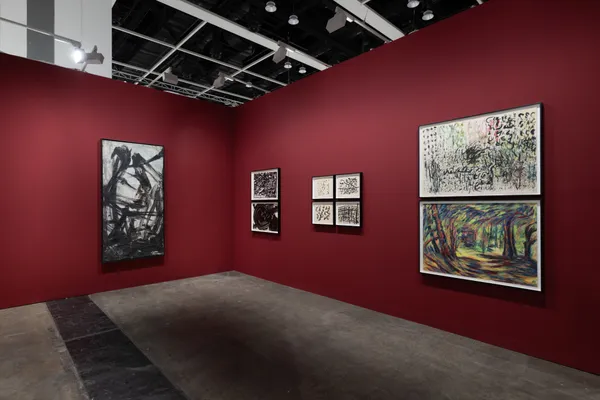
Tang Chang (1934–1990), also known as Chang Sae-tang, was a self-taught artist and poet who shattered the conventions of Thai modernism. Born into Bangkok’s Chinese diaspora, his education was cut short by war, yet this rupture became the ground for radical independence. Without institutional training, he forged a practice that fused calligraphy, abstraction, and poetry into a language of defiance and reflection.
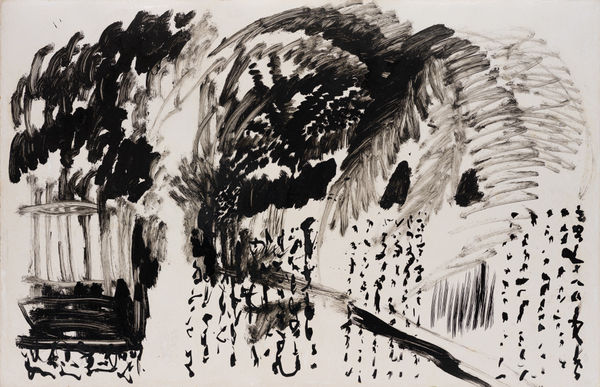
Chang painted with his body—fingers, hands, and gestures pressed directly into canvas—transforming ink into rhythm, urgency, and spiritual search. His canvases collapse the boundary between writing and painting, while his more than four hundred self-portraits form an uncompromising archive of selfhood: existential documents probing solitude, diaspora, and belonging. In his final years, vivid landscapes of his Bangkok neighborhood captured urban transformation as a mirror of mortality and change.
Chang was not only an innovator but also an activist and mentor. He championed young talents across visual art, music, and literature, insisting that creativity must remain free from hierarchy and nationalism. His refusal to conform, his embrace of cross-disciplinary exchange, and his insistence on independence mark him as a radical pioneer whose legacy continues to shape Thai art. As Nawapooh Sae-tang’s thesis observes, Chang’s “misfit” position—outside institutions, refusing to sell his works, affirming his Thai-Chinese identity—made him both marginal and indispensable, unsettling the canon of Thai modernism while becoming central to its alternative currents.
International recognition has begun to reposition Chang within global narratives of abstraction. Landmark exhibitions at the Centre Pompidou and the Smart Museum of Art, The University of Chicago have underscored his significance, situating his practice alongside the most daring experiments in modernism worldwide.
The forthcoming opening of the Tang Chang Private Museum in Bangkok (1 May 2026), a dedicated institution that will illuminate his legacy in depth, secures his position as one of the most powerful pioneers of Thai modernism—an artist whose body, ink, landscapes, and poetry remain urgent, uncompromising, and profoundly global. In June 2026, gdm Hong Kong will present Tang Chang’s solo exhibition.
-
 Untitled, 1982
 -
Untitled, 1982
-
Untitled, 1982
-
Untitled, 1963
-
Untitled, 1970
-
Untitled (Neighbourhood), 1987




-
Tang Chang
The Tang Chang Private Museum Opening featured in the South China Morning Post April 28, 2026The opening of The Tang Chang Private Museum in Bangkok was featured in the South China Morning Post in an article by Enid Tsui, marking...Read more -
Tang Chang
Grand Opening of the Tang Chang Private Museum April 7, 2026The Tang Chang Private Museum to open its doors on 1 May 2026, accompanied with a packed opening program including an inaugural exhibition, symposium, and...Read more -
Tang Chang
Kabinett | gdm at Art Basel Hong Kong 2026 March 1, 2026gdm is thrilled to announce upcoming solo presentation by Tang Chang for the gallery's Art Basel Hong Kong 2026 Kabinett sector. Tang Chang (1934–1990), also...Read more -
Tang Chang | Calligraphic Abstraction
ArtAsiaPacific September 15, 2025Tang Chang's solo exhibition 'Calligraphic Abstraction' at Bangkok Kunsthalle is featured by ArtAsiaPacific, reviewed by Christina Bartosch. Nestled in Bangkok’s packed Chinatown, the Bangkok Kunsthalle,...Read more -
Frieze Seoul 2025
ARTouch September 7, 2025gdm's presentation in Frieze Seoul 2025 is featured by ARTouch. gdm returns to Frieze Seoul this year with a presentation of important historic works by...Read more -
Tang Chang
Frieze June 25, 2025Tang Chang's solo exhibition 'Calligraphic Abstraction' at Bangkok Kunsthalle is reviewed by Kamori Osthananda for Frieze Exhibition Reviews. The Pali Buddhist word ekaggata (unified mind)...Read more